LICM (loop-invariant code motion) is an LLVM optimization pass that moves a loop-invariant instruction out of its loop. A loop-invariant instruction produces the same result on every iteration. LLVM applies LICM only when it can prove that program behavior remains unchanged.
Moving an instruction to a point before its loop is called hoisting. In the following transform function, the multiplication and addition that produce factor are hoisting candidates.
The Same Computation on Every Iteration
unsigned is a C integer type that represents nonnegative values. input and output each point to count elements of that type, and count is nonnegative. When count is positive, the loop variable i ranges from 0 through count - 1. scale and offset are function arguments, and factor is the result of scale * scale + offset.
// licm.c
void transform(const unsigned *input, unsigned *output,
               int count, unsigned scale, unsigned offset) {
  for (int i = 0; i < count; ++i) {
    unsigned factor = scale * scale + offset;
    output[i] = input[i] * factor;
  }
}
An operand is a value consumed by an instruction. Neither scale nor offset changes inside the loop. The expressions scale * scale and scale * scale + offset are therefore loop invariant.
i increases on every iteration. The addresses of input[i] and output[i] change with it. In the unoptimized IR, the factor computation sits in the loop body and repeats once for every executed iteration.
IR Immediately Before LICM
clang is the frontend that translates C to LLVM IR, and opt is the optimizer that runs passes on IR. Both tools come from Homebrew LLVM 22.1.81. In the commands, LLVM_BIN is the directory containing those LLVM executables. -fno-discard-value-names preserves C identifiers in IR names, and -Xclang passes the following option to clang’s internal frontend. -disable-O0-optnone suppresses the optnone attribute.
Local names in LLVM IR follow SSA (static single assignment) form. SSA defines each virtual register once. A phi instruction selects a value according to the preceding basic block from which control arrived. A basic block is a sequence of IR instructions that executes from top to bottom with no branch in the middle.
The header is the first basic block reached when control enters a loop from outside. The preheader is the single entry block outside the loop that leads only to the header. A backedge is control flow from inside the loop back to its header, and the latch is the block from which the backedge starts. An exit block is reached after control leaves the loop.
Before LICM, the IR passes through mem2reg, loop-simplify, and lcssa.
| Pass | Role |
|---|---|
mem2reg | promotes eligible local variables created by alloca into SSA value flow |
loop-simplify | ensures Loop Simplify Form, with a preheader, one backedge, and dedicated exit blocks reached only from inside the loop |
lcssa (loop-closed SSA) | routes values defined inside the loop and used outside it through phi nodes in exit blocks |
A loop pass processes one loop at a time. LLVM automatically runs loop-simplify and lcssa before a loop pass. raw.ll is the IR emitted by clang, and before.ll is the IR after the three preparation passes. The preparation makes before.ll readable and leaves only LICM’s changes in the later comparison.
LLVM_BIN=/opt/homebrew/opt/llvm/bin

"$LLVM_BIN/clang" -O0 -Xclang -disable-O0-optnone \
  -fno-discard-value-names \
  -S -emit-llvm licm.c -o raw.ll

"$LLVM_BIN/opt" -S \
  -passes='mem2reg,loop-simplify,lcssa' \
  raw.ll -o before.ll
transform uses no loop-defined result outside the loop, so lcssa adds no new phi node to before.ll.
With file-level settings, parameter and function attributes, and metadata removed, transform reads as follows.
The target triple in before.ll is arm64-apple-macosx15.0.0. On arm64-apple-macosx15.0.0, pointers are 64 bits and both int and unsigned are 32 bits.
define void @transform(ptr %input, ptr %output,
                       i32 %count, i32 %scale, i32 %offset) {
entry:
  br label %for.cond

for.cond:
  %i.0 = phi i32 [ 0, %entry ], [ %inc, %for.inc ]
  %cmp = icmp slt i32 %i.0, %count
  br i1 %cmp, label %for.body, label %for.end

for.body:
  %mul = mul i32 %scale, %scale
  %add = add i32 %mul, %offset
  %idxprom = sext i32 %i.0 to i64
  %arrayidx = getelementptr inbounds i32, ptr %input, i64 %idxprom
  %0 = load i32, ptr %arrayidx, align 4
  %mul1 = mul i32 %0, %add
  %idxprom2 = sext i32 %i.0 to i64
  %arrayidx3 = getelementptr inbounds i32, ptr %output, i64 %idxprom2
  store i32 %mul1, ptr %arrayidx3, align 4
  br label %for.inc

for.inc:
  %inc = add nsw i32 %i.0, 1
  br label %for.cond

for.end:
  ret void
}
The five basic blocks have the following roles.
| Basic block | Role |
|---|---|
entry | function entry and preheader, the only block outside the loop that enters for.cond |
for.cond | header, checks i < count and branches to for.body or for.end |
for.body | loads an array element, multiplies it by factor, and stores the result |
for.inc | latch, increments i and follows the backedge to for.cond |
for.end | exit block reached after control leaves the loop |
The IR instructions split the C loop as follows.
| IR | Meaning |
|---|---|
ptr, i1, i32, i64 | pointer, one-bit integer, 32-bit integer, and 64-bit integer types, respectively |
br label, br i1 | branch unconditionally to another basic block or branch according to an i1 condition |
%i.0 = phi ... | select 0 on the first iteration and %inc on later iterations |
%cmp = icmp slt ... | compute i < count with a signed less-than comparison |
%mul, %add, %mul1 | compute scale * scale, %mul + offset, and input[i] * factor, respectively |
%idxprom, %idxprom2 | sign-extend i from i32 to i64 with sext for the input and output addresses, respectively |
%arrayidx, %arrayidx3 | compute the addresses of input[i] and output[i] with getelementptr inbounds; inbounds promises that each address stays within the permitted range of the same allocated object |
%0 = load, store, align 4 | load input[i] from %arrayidx into %0 and store %mul1 through %arrayidx3; the addresses of 32-bit unsigned elements are aligned to a four-byte boundary |
%inc = add nsw ... | compute i + 1; nsw promises no signed overflow, which follows from nonnegative count and i < count |
Running LICM
-passes='licm' selects LICM as the transforming pass. LLVM 22 opt automatically prepares Loop Simplify Form, LCSSA, and MemorySSA2. MemorySSA records use-def relations from each memory use to its reaching definition and which writes may change a loaded value.
after.ll is the result of running LICM on before.ll. diff -u compares two text files line by line. -I '^; ModuleID' excludes the ModuleID comment, which contains only the input filename.
"$LLVM_BIN/opt" -S \
  -passes='licm' \
  before.ll -o after.ll

diff -u -I '^; ModuleID' before.ll after.ll
The function body changes by four lines. A - marks a line removed from before.ll, and a + marks a line added to after.ll.
 entry:
+  %mul = mul i32 %scale, %scale
+  %add = add i32 %mul, %offset
   br label %for.cond

 for.body:
-  %mul = mul i32 %scale, %scale
-  %add = add i32 %mul, %offset
   %idxprom = sext i32 %i.0 to i64
%mul and %add move from for.body to entry. Every path from function entry to for.body passes through entry. This relation is called dominance: entry dominates for.body. The moved definition of %add therefore executes before %mul1 uses %add.
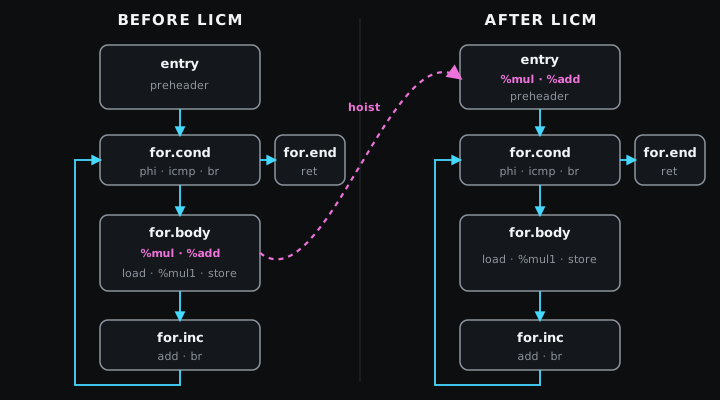
When count is zero, for.body does not execute, but the hoisted %mul and %add execute once in entry. Both instructions keep the low 32 bits of their results and neither reads nor writes memory. LLVM IR defines their result for every scale and offset, so speculative execution (running them before they are known to be needed) is safe.
This LICM path checks three conditions before moving an instruction unchanged into the preheader.
- Every operand of the instruction must be loop invariant.
- Memory reads, memory writes, calls, and other externally visible behavior must remain unchanged.
- Speculative execution on paths that did not execute the original instruction must be safe.
%mul and %add satisfy all three conditions.
Why an Invariant Division Stays in the Loop
transform_div multiplies each array element by numerator / denominator. numerator is the dividend, and denominator is the divisor. input and output each point to count unsigned elements, and count is nonnegative. When count is positive, the range of i is 0 through count - 1.
// licm_div.c
void transform_div(const unsigned *input, unsigned *output,
                   int count, unsigned numerator,
                   unsigned denominator) {
  for (int i = 0; i < count; ++i) {
    unsigned factor = numerator / denominator;
    output[i] = input[i] * factor;
  }
}
transform_div goes through mem2reg, loop-simplify, lcssa, and licm in that order. %div remains in for.body after LICM. udiv is the IR instruction that divides two unsigned integers and defines the quotient as %div.
for.body:
  %div = udiv i32 %numerator, %denominator
  ; instructions that load input[i], multiply by %div, and store to output[i]
When count is zero, for.body does not execute. The original function performs no division on that path even when denominator is zero. Moving %div into entry could introduce a division by zero. LLVM IR defines division by zero as undefined behavior, an execution for which LLVM specifies no result or subsequent behavior. Both operands are invariant, but speculative execution is unsafe, so LICM leaves %div in place.
Memory instructions need proofs beyond the address itself. Aliasing is the possibility that different pointers refer to the same memory location. Even a load from a loop-invariant address can change when a store or call in the loop modifies an aliased location. LLVM uses alias analysis and MemorySSA to find conflicting writes, then separately checks whether reading the address is safe on a path where the loop executes zero times.
A volatile access is a memory access that the compiler may not omit or merge. It cannot be hoisted because its execution count is externally observable. For an ordinary call, call semantics, attributes, and analyses must first prove that its memory effects and other side effects permit movement. LICM then checks the remaining conditions.
References
- LLVM’s Analysis and Transform Passes: LICM: LICM behavior and conditions for moving memory instructions.
- LLVM Loop Terminology: definitions of headers, preheaders, latches, exits, and Loop Simplify Form.
- Using the New Pass Manager:
opt -passessyntax and automatically selected pass scope. - MemorySSA: memory use-def relations and conflict queries using alias analysis.
- LLVM Language Reference:
udiv: unsigned division and the semantics of a zero divisor. - LLVM 22.1.0 LICM implementation: the implemented hoisting checks and use of MemorySSA.
The commands and IR use Homebrew LLVM 22.1.8 from
/opt/homebrew/opt/llvm/bin. IR spelling and pass-manager structure can change in other LLVM versions. ↩︎On LLVM 22.1.8,
-passes='licm' -print-pipeline-passesprintsfunction(loop-mssa(licm<allowspeculation>)),verify.loop-mssaprovides MemorySSA to LICM, andfunction(...)applies the loop pass to each function in a module. A module is the contents of one IR file.allowspeculationpermits speculative execution after the safety checks pass, whileverifychecks the structure of the transformed IR. ↩︎